
What happens to parenthood when a marriage ends?
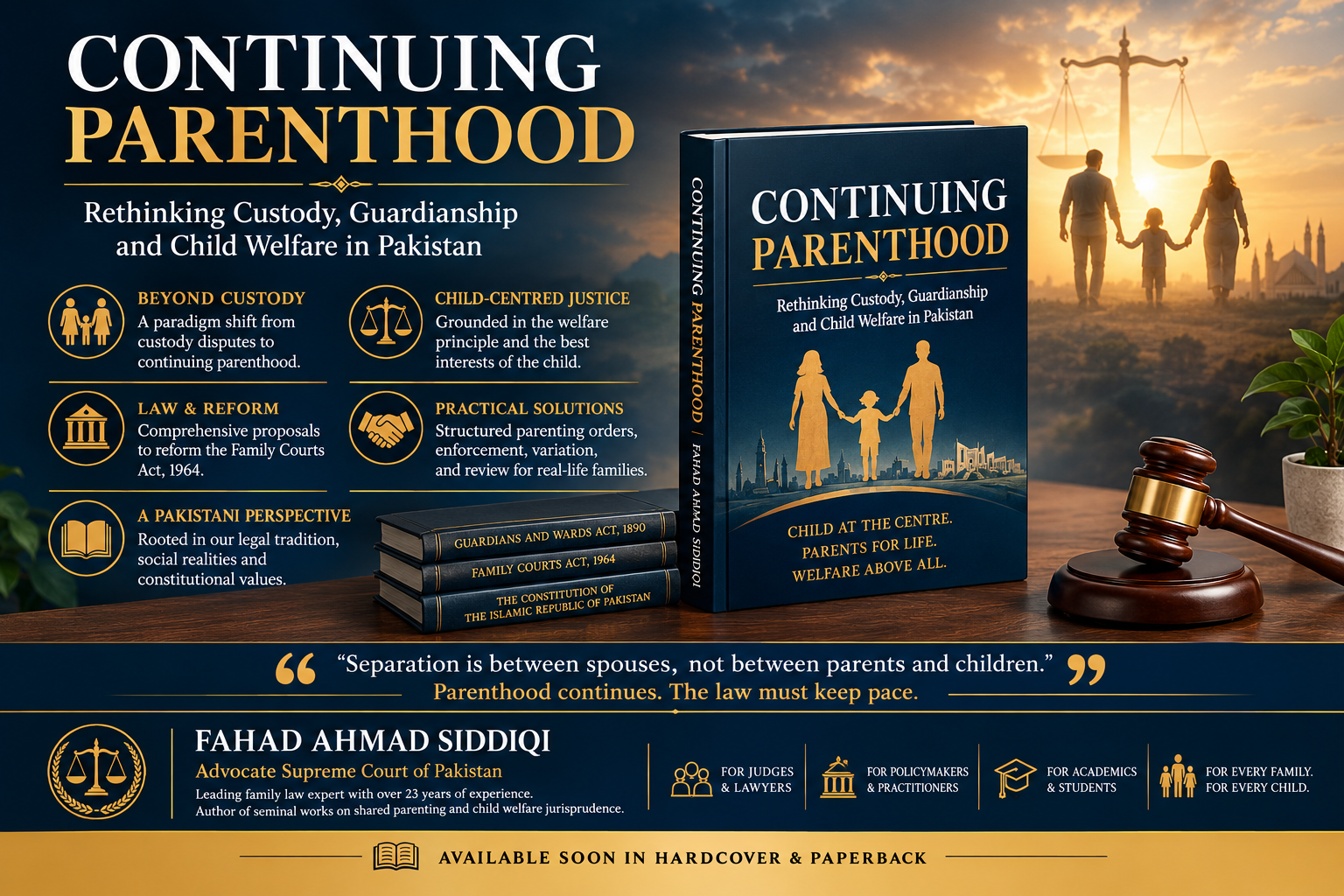
This is the central question of my forthcoming book, Continuing Parenthood: Rethinking Custody, Guardianship and Child Welfare in Pakistan a work that brings together more than two decades of my experience in litigation, legal research, writing and advocacy in the field of child custody, guardianship and family justice.
Over the years, I have appeared in, studied and written about disputes in which the formal language of “custody” and “visitation” often fails to capture the reality of a child’s life after parental separation. I have seen how a parent can gradually become peripheral to a child’s life, not necessarily because that parent is unfit, but because an interim order, a restrictive visitation arrangement, prolonged litigation, institutional practice or repeated delay has altered the relationship.
Those experiences have shaped the central proposition of this book:
When a marriage ends, parenthood does not.
This proposition does not mean that every separated parent should receive equal physical time with a child. Nor does it diminish the role of the primary caregiver or the Court’s protective jurisdiction. Where abuse, violence, neglect, abduction risk or other genuine welfare concerns exist, the law must be capable of imposing appropriate and proportionate restrictions.
But where a parent-child relationship is safe, meaningful and beneficial to the child, residence with one parent should not automatically reduce the other parent to the status of a visitor.
The book therefore seeks to bring together, within a single jurisprudential framework, questions that are too often considered separately in Pakistani family law: custody and guardianship, parental responsibility, shared parenting, meaningful parenting time, overnight and at-home contact, the child’s voice, relational harm, interim orders, delay, enforcement and maintenance.
It asks whether the traditional vocabulary of “custody” and “visitation” remains adequate for the realities of contemporary post-separation family life.
At the heart of the book is a shift in the question the law asks.
Instead of asking merely:
“Which parent should have custody?”
or:
“When may the other parent see the child?”
the more fundamental question should be:
“How should parenthood continue after separation in a manner consistent with the child’s welfare?”
This is not simply a theoretical question. It has consequences for how courts formulate interim orders, structure parenting time, determine guardianship, hear children, address relocation, enforce parenting arrangements and evaluate the effects of prolonged litigation.
One of the most important dimensions examined in the book is time.
An interim restriction imposed for a few weeks can continue for months. Months can become years. A temporary arrangement can become the child’s lived reality. By the time a final judgment is delivered, the relationship that the Court was originally expected to protect may already have been substantially altered by the process itself.
Family justice, therefore, cannot be assessed solely by asking whether the final order was legally correct. The process by which that order is reached is itself part of the welfare inquiry.
My work in this field has also led me beyond individual cases and towards questions of legal and institutional reform. The book consequently moves from jurisprudence to proposals for a more child-centred Family Court system: meaningful parenting arrangements at the commencement of litigation; reasoned and reviewable restrictions; appropriate mechanisms for hearing the child’s voice; professional assessment where required; enforceable parenting time; procedural fairness in interim proceedings; continuing interim maintenance; and a clearer framework for joint guardianship and shared parental responsibility.
These proposals are not presented as abstract policy preferences. They emerge from years of observing how family litigation operates in practice and from the recurring gap between the principle of child welfare and the lived experience of children and parents navigating the family justice system.
My earlier writings including my work on non-custodial fathers, shared parenting and Pakistani family jurisprudence have been part of that continuing intellectual journey. Continuing Parenthood brings those strands together and seeks to take the argument further: from advocating individual parenting rights towards reconsidering the legal conception of parenthood itself after separation.
The book is therefore not intended merely as another work advocating greater visitation. Nor is it framed as a contest between “fathers’ rights” and “mothers’ rights.”
Its central concern is the child.
Where circumstances permit, the law should preserve meaningful family relationships rather than allow separation, litigation or institutional practice to produce unnecessary parental disappearance.
This is ultimately a book about continuity.
A marriage may end.
A household may divide.
But parenthood does not have to disappear with either.
A child should not have to lose a parent merely because the parents have lost their marriage.
Continuing Parenthood: Rethinking Custody, Guardianship and Child Welfare in Pakistan represents the culmination of more than two decades of my professional engagement with child custody, guardianship, family litigation, legal scholarship and reform advocacy.
It is, in many ways, the work towards which that journey has been leading me.
I have spent years representing parents before Pakistani courts, examining the jurisprudence that governs their relationships with their children, writing about the shortcomings of the existing framework and advocating for a family justice system that places the child’s welfare at the centre of every decision.
This book is an attempt to bring those experiences, questions and proposals together in one sustained argument.
It is not merely a book about custody after divorce.
It is an argument about what parenthood itself should mean after separation.
And it is an invitation to Pakistani courts, legislators, lawyers, academics and policymakers to reconsider whether our family justice system should merely determine where a child lives or whether it should also protect the continuing relationships that make a child a child of both parents.
Fahad Ahmad Siddiqi
Advocate Supreme Court of Pakistan